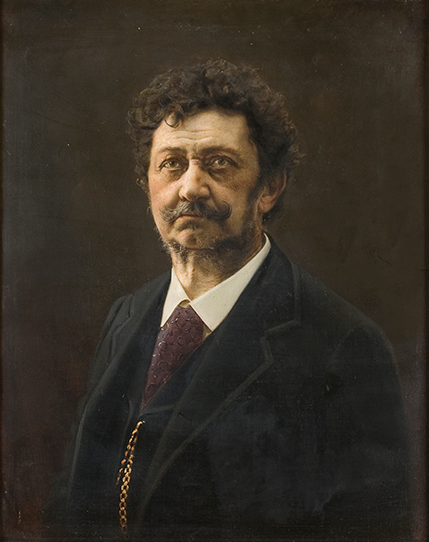
About Laza Kostić
The creator of the magnificent poems Santa Maria della Salute and Among awareness and the dream, the playwright of works such as Maxim Crnojević and Pera of Segedin, the famous Laza Kostić was a pioneer in everything he touched! There is not a single Serbian writer, musician, or painter who excelled in as many diverse disciplines as Laza Kostić! A theatre critic, polyglot, and one of the finest orators of his time, he earned a doctorate in law at the age of 25, in Latin, in Pest. He devoted fifty years to the study of Shakespeare, more than anyone else in his era. He translated Romeo and Juliet and Hamlet into Serbian, and organised the 300th anniversary of the Bard’s birth in Novi Sad—thus making the “Serbian Athens” one of only six cities in Europe to mark Shakespeare’s 300 th anniversary! For the occasion, he composed and sent an Ode to Shakespeare to the Shakespeare Library in Stratford. He was also a music critic, diplomat, national tribune of the people, patriot, philosopher, translator, the first president of the Association of Journalists of Serbia (1881), a sportsman, and the inaugural president of today’s Rowing Club “Danubius”—then known as the “First Association of Firefighting, Rowing and Strengthening” (1872)—as well as an amateur actor.


An Orthodox, liturgical Christian, he fasted, confessed, and took communion—not only during his seven-year stay at the Monastery of Krušedol, but throughout his entire life. He dedicated fifty years to Shakespeare, sixty to sport, and his faith he pursued steadfastly for nearly seventy years—from his earliest childhood until his final breath.
Born on the feast of the Three Holy Hierarchs (12th February 1841, in Kovilj)—a day honouring saints who embody wisdom, courage, and eloquence—he passed away on the feast of Saint Alypius the Stylite (9th December 1910, in Vienna), the personification of perseverance. He was laid to rest in the Palanački family tomb, together with his wife Julijana, her aunt Marija, and mother, also Marija, in Sombor.
Funding sources come from donations.
If you would like to support the work of the Laza Kostić Fund, you can do so by making a donation.